Who are the men in the purple costumes? Stephanie Sy-Quia has questions about sport, and about the boyfriends who keep making her watch it.
My university boyfriend wanted me to watch him play football. I was nineteen, he was a grad student 6.5 years older than me. At nineteen, that .5 felt significant. He told me early on that his type was “younger women”.
He wanted me to come watch him play football on Saturdays. Football season ran from October to March. At first I demurred vaguely: “Maybe” or “sometime soon”. But it transpired that he really wanted me to come. So I explained: I’m sorry, but I don’t think that would be enjoyable for me. I’d have to cycle out of town and stand on the edge of a field in the cold, and just watch you? Besides, I wouldn’t know what I was looking at, because sport doesn’t interest me, so I wouldn’t even know when to make the right noises. I found the whole concept of watching sports a bit ridiculous: it seemed to me to be something men did in order to have a safe conduit for their emotions.
I did not say this to him. What I did add was that afterwards he would want to hang out with his teammates, to go to the pub, and I was of an age where I hadn’t really gotten the hang of going to the pub, of sitting there for hours drinking pints, of making conversation or of being funny.
You won’t want to talk to me, I said. Besides, I said, this is something you do with your friends. You don’t need me to be in every part of your life. I resent the expectation that, as your girlfriend, I am supposed to get on board with all of your hobbies. That’s what you have friends for. I have hobbies which you think are quaint but I don’t care because they have nothing to do with you.
Side note here: I don’t like sport, I never have, I think there’s something militaristic about it. Yes, of course physical activity is good for you, and team sports build cooperation, and training promotes discipline. But the ideal of physical health held up in our culture is a militarised one, one guided by one’s perpetual readiness to bear arms. I think it absurd that US colleges have sports scholarships, so access to higher education can be mediated through the ability of the body. The sports prioritised in the British private education system are those of empire: team sports that allow you to pitch up anywhere in the world and network with the “right sort of chap”; sports which have high barriers to entry due to equipment, location or cost: tennis, sailing, skiing. In contrast, sports which are conducted alone, like running or swimming, in which one can find a state of meditative silence, are less valued in such a system.
Perhaps worst of all, I think our sporting culture overpromotes discipline to the detriment of teaching people to rest. By all means, sport is good for you, but so is gardening. And the presumed neutrality of men’s sport, its elevation over women’s, the amount of money spent on it, cultural space dedicated to it, makes me angry. When the European Super League plans were announced, then reversed, due to a huge outpouring of fan rage, I cycled through Chelsea past the stadium. The streets were still crunched with a crust of broken glass. I thought: wow. Imagine what we could achieve if this demographic got this angry about other things too.
Anyway, eventually my boyfriend cajoled me into going to watch him play. He told me it was really important to him and would mean a lot to him. I went. It was February, and the churned ground was hard with frost. The cold crept up into my feet through the soles of my boots. I didn’t know anyone else on the sidelines and there were only three of us there. Gary didn’t look at me for the whole duration of play. When the game ended, he spent such a long time talking to the other players, his back turned to me, that I assumed he was ignoring me. I did something I shouldn’t have done. I got on my bike and cycled back to my house share. He was furious. We broke up not much later, over the fact that he wanted me to move to Vancouver with him.
Looking back, I might have expressed myself about the football more gently. But I don’t regret trying to say no and being clear about why. If I had to stretch the incident into an overall symptom of what was wrong in our relationship, I would say that it was indicative of his expectation that I merge totally into his life, follow and support him wherever he might be, in whatever endeavour, regardless of whatever interest or enjoyment it might entail for me.
“That is a fifteen-year-old!”
Shortly after that relationship ended, I embarked on the long relationship of my twenties. We had been best friends before, lived together at university (in that same house share I had cycled back to, wiping angry tears out of the corners of my eyes), and then tentatively began going on dates once I’d moved to London. He was and is one of the kindest people I have ever met, and approached our relationship with a lot of patience and great effort towards mutual understanding. I think he was amused by my belligerent ignorance of sport. We were in a pub once and Aston Villa were playing. I asked who the men in the purple costumes were. I asked him what “part” he’d played in rugby at school.
And he loved cricket. He asked nothing of me in relation to it, but because he loved it and I loved him, I wanted to show marginally more willingness to engage than in my previous relationship. I asked him to explain the game to me several times, and each time the rules seemed more and more esoteric. Eventually I just gave up, and let the strange idiom of the game wash over me when he talked about it.
I did, however, learn the names of several key cricket players (Jimmy Anderson, Joe Root and Ben Stokes), and then would ask after their performance at the end of an Ashes or a Test Match day. Freddie would launch into an animated recounting, and I would smile and nod. He knew I didn’t understand but I hope he understood what I was trying to communicate by asking: that I valued the things he valued, because he did. That I loved him and respected the things he found interesting.
He said, of Test Matches, “It’s like the greatest story ever told, and you never know how it’s going to end!” I watched US comic Reginald D. Hunter react to the news that Test Matches lasted five days by saying, “That’s like having sex all day and nobody comes.” I got used to the abstract poetics of TMS on the radio all through the summer months. It was, to me, what the Shipping Forecast is to so many of us: a kind of incantation, more soundscape than language; soothing even as it is unintelligible.
He played cricket too. He was understanding when I said I didn’t want to go see him. I don’t think he ever wanted that from me, in fact. Once though, he was wicket-keeping, a position he didn’t normally play. His dad offered to walk me over to the club so I could see. I agreed. We’d been together a good chunk of time by that point, and I was satisfied that this wouldn’t set a dangerous precedent.
My not-quite father-in-law walked us over to the pitch. We came in through the white picket gate and walked up the side, past the players, to the clubhouse. There was a sort of WAG enclosure, where a small group of middle-aged women sat with pint glasses of Pimms. “Hello ladies,” said my non-father-in-law, “this is Stephanie, Freddie’s girlfriend. She doesn’t know a thing about cricket.” There was a frisson of rueful laughter among the WAGs. One of them introduced herself as Pam and said, “Do you like drinking and sitting in the sun?” I did. “Well then, you’ll be just fine. Come sit by me. I’ve been doing this for thirty years and I still have no idea what’s going on.”
We sat and chatted in our striped deckchairs. It was all quite graceful and sedate: the men in their beautiful knitwear, windmilling their arms, the bright green of the grass, the ball the colour of a lipstick and the pleasing clack when the bat hit it. The players were far away, but I thought how Freddie looked good in the white trousers, how I loved the spread of his shoulders. It was as I was doing this the players took a break, and while I was waiting for him to walk up from the opposite end, he appeared at my elbow, eating a sausage. I looked from him to the man I’d been ogling and back. “You said you were wicket-keeping!” I said. “I’ve been bowling,” he said with mock petulance. “And that –” gesturing to the other guy – “is a fifteen-year-old!”
All that summer, from the first weekend of April until the last of August, he played. He was working outside London during the week, so he’d be away Monday through to Thursday. On Fridays he would take his cricket bag into work and head straight back to his parents’ from there. He would play all day Saturday, because that’s how long cricket takes, and then, more often than not, stay overnight and not leave until after lunch on Sunday. I tried to schedule a date for the two of us and he was an hour and half late, because the person who’d been driving him back from the match had taken two wrong turns. It wasn’t his fault but it felt like a metaphor: me dolled up on my own, nursing a wine while our food stayed under the lights at the pass, the kitchen already closed.
Don’t these men have friends?
I loved him dearly, but we broke up too. This time I stayed single for a while. I was on Hinge for a time, and there was baffled by the number of men who said they wanted a partner who could “join on bike rides”, “ski”, “enjoys activities at the weekend”, “is active” or whose “ideal Saturday” was “F1 and a roast”.
There seemed to be a tipping point, around the age of 32, where beer bros became bike men, and tightly-fitting Lycra took over their profiles. I thought: don’t these men have friends? This is what your friends are for. I didn’t, and I still don’t, believe that you need to share hobbies with a partner. They cannot meet your every need, nor should they.
On my first date with my current (and possibly forever) boyfriend, which was in April, I asked him if he was going on any trips this coming year (tangentially: this is a good thing to ask someone in order to suss out their attitudes to money and saving, and therefore your financial compatibility with each other). He said the US in June. When I asked him what was taking him there, he gave me a wry little smile and said, “There’s this thing called the World Cup which will be on…”
I thought: oh no. Here we go again. So I came out with it, figuring that blunt and early was best: that I don’t like sport, think it’s militaristic, resent the elevation of men’s sport, and didn’t believe that partners were supposed to have (let alone adopt) each other’s interests, and that every time there’s a major sporting tournament and it gives the St George’s cross licence to be everywhere in public, it makes me flinch. I said that I respected his love for the beautiful game but it really wasn’t my thing, thank you very much.
He was very self-deprecating about it in response: that he had always loved it, it formed a huge part of his childhood, so much so that he’d had two knee surgeries before he was 18; that it was one of the main ways he spent time with his grandfather and dad. I said great, that’s wonderful. But please don’t expect me to take an interest. He seemed to think this was fair enough, and I breathed a sigh of relief.
However, as time wore on and I fell head over heels, and World Cup summer was inescapable, I found myself paying more attention than I ever have previously. Without trying, I learned the names of key players – Lamine Yamal became my favourite. I had been dimly aware before, since the 2018 tournament and the Euros in between, in the way that is inevitable with inescapable news events. I knew some of the England players by attribute but not by name: there was the one who was really good at penalties, the one with the nice legs, the handsome one, the really young one, the one that looks like Princess Diana. Now though, I learned their names and basic facts about them: Declan Rice had recently had a glow-up, Jude Bellingham dresses incredibly well. My knowledge went international too: McTominay had also had a glow-up by moving to Naples, Ronaldo was the one who got his girlfriend a diamond so big you could use it as a bottle opener, Mbappé has a great collection of handbags.
Watching the matches with my male housemate, I still didn’t know what I was looking at. I watched the Ghana game and used the first person plural to refer to the England team. He was shocked. “Your boyfriend has changed you,” he said. “This is major character development.” I said that if the match were a Scrabble game, I’d want to see the board opened up. “This is very apt,” said my boyfriend when I texted him. He was in the States then, and I was away when England lost in the semi-final. He was so sad, and I thought he was joking at first. I didn’t know what to say to comfort him, but I did shift from joking to serious in order to try.
What fresh shithousery was this?
We were reunited for the final, Argentina versus Spain. We watched it in a pub and I sat on his lap because there weren’t enough chairs. I gasped at Argentina’s behaviour a lot and no one else seemed all that surprised. I surprised myself by getting angry when the Argentinians messed with Yamal, shouting at the screen that he must be protected at all costs, how dare they, get their hands off him. Several of the Argentinians had dodgy tattoos, one which looked suspiciously like (and yet just-plausibly unlike) the eagle of the Third Reich, another with a sort of disguised, extra-leggy swastika. I joined everyone by hating them. What an ugly way to play the beautiful game! What dirty football! What fresh shithousery was this?
When the first half came to a close and no one had scored, I leant into my boyfriend’s ear and said, “I’ve had sex like this before”: where it just goes on for hours and nothing happens, and the chafing sets in, and you gird yourself for the UTI that is to come. He laughed and said this was the sports commentary we all deserved. I don’t know if he was humouring me. It was good to sit in his lap. He joked about needing fresh legs and I got the joke. Also like sex were the noises I was making: not in their sound, but in the fact that I was not in control of them; they were atonal expressions of emotion that just came out of me, seemingly in sync with everyone else in the pub. It was a curious loss of autonomy. I didn’t dislike it. When Torres scored and made talking shapes with his hands, silencing the haters, I thought it was a Spanish thing, that they were castanets.
In a way I am relieved that England didn’t make it to the final. No matter the outcome, it would have taken over our evening, when we’d only just been reunited after being apart for over three weeks. But I already know that I won’t be wishing that for the next World Cup or Euros, because I will have been with him long enough that I won’t be jealous of the football. I still won’t understand it, I will still be bemused about its cultural centrality, and there will still be things about it which make me angry. But in the end, what sport has taught me is how to love: to demonstrate respect for what your love loves; to surrender, at times, one’s understanding to an unfolding drama; to run into the unknown and give it your all, no matter the outcome.
Some names have been changed.
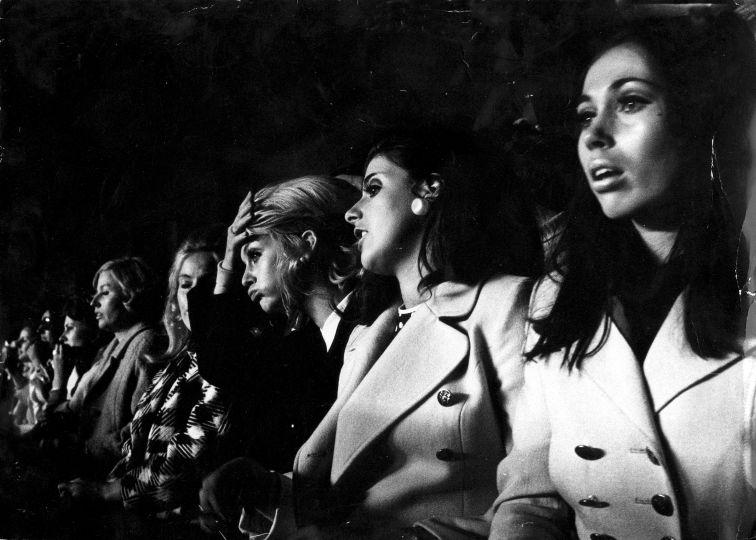
Lead image: Ajax players’ wives watch the 1969 European Cup final in Madrid, which Ajax lost 4-1 to AC Milan. From right: Yvonne van Duivenbode, Maya Suurbier, Danny Cruyff, Andrea Swart and Carla Suurendonk. Image: Nationaal Archief / Spaarnestad Photo, SFA001002842, via Flickr Commons
Read next: The World Cup comedown
Got a story like this? Pitch it to us.


Leave a Reply