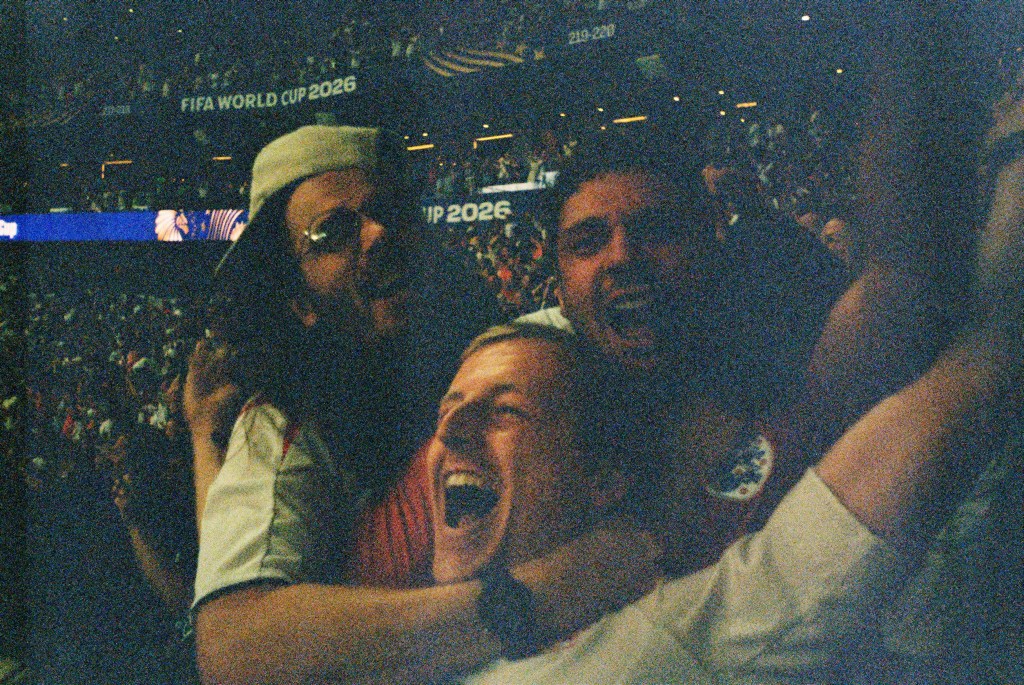
After following England to the 2026 World Cup, James Bayley considers why football gives grown men permission to get emotional, and why it hurts so much when it ends.
I folded my England shirt and put it in the drawer, and the gesture felt exactly like taking down the Christmas decorations.
That is the closest I can get to explaining it: seven Christmas Eves and seven Christmas mornings in the space of six weeks, each one better than the last, and you are permitted to be a fully grown adult with unbridled emotions, allowed to enjoy and express yourself without fear of judgement. An excuse to feel proud of where you come from, to sing the national anthem for the sake of singing, in unison, with a load of grown men. Every goal a present to unwrap, every big game preceded by hours that behave like Christmas Eve.
And then it stops, and you are supposed to simply carry on with life.
Measuring life in World Cups
I measure time in World Cups. How old will I be at the next one? How old will my dad be? It is a calendar with four-year gradations, and I have been using it since I was eight.
That was 2002, when in the summer the adults bent the rules just because it was the World Cup. English lessons were cut short to make room for mid-morning watch parties. England lost to Brazil, but we emulated our fallen heroes at lunchtime the same day, the Year 3 versus Year 4 clásico. We were England, they were Brazil. We were the younger underdogs. We lost, but we lost heroically, which is basically the same as winning, just like Dunkirk.
A year on, I was a flag bearer for England. The match was against Serbia & Montenegro at the Walkers Stadium in Leicester. My dad had entered the competition on my behalf at the last minute by phoning the local paper, pretending to be me to answer the question: in what year did England win the World Cup?
“Nineteen sixty-six,” said the deep bass pretending to be a child at midnight.
This summer I bought that same shirt, the one England wore when I was a flag bearer. I paid extra for 24-hour delivery. It arrived a day late, the day after England lost to Argentina.
Throughout my youth, I cast myself as England’s hero, in the garden rewriting history or on the PlayStation, choreographing last-minute winners with the care of a man arranging the music for his own funeral.
Sometimes I played as my virtual pro with Italian commentary on, in the hope I would passively become fluent and so not render the act of playing a video game completely futile. For the admin, replying to computer-generated emails and scouting players, I would put on audiobooks.
An email arrives in my in-game inbox. “Dear Mr Bayley, your scouting report is ready for James Bayley Jr.”
Behind me, the audiobook is still running.
“Can’t repeat the past? Why, of course you can.”
Going to America
On the flight to America, I felt an anticipation normally reserved for coming-of-age events, the kind where you picture what your life will be like afterwards.
I hadn’t let myself enjoy any of it until England’s place in Atlanta was confirmed. Everything was booked, no way back and in typical fashion it went to the wire after a 0-0 with Ghana.
I watched the Panama game in a bar in DC, incapable of small talk, making the worst possible first impression on several new friends. Goalless at half-time, I had already accepted my fate: an inordinate sum spent to watch group winners Croatia in Atlanta.
Then England scored and the months of not knowing and the weeks of anxiety and the minutes of sheer dread evaporated into a euphoria that retrospectively justified all of it.
That is the drug.
This is where the trip properly begins, though I already knew I had secured some once-in-a-lifetime snaps on the film camera in the hours after Panama. The kind of images that stay imprinted, that feel as though they are still moving in your mind and closer to real life.
I was also wearing a vintage Umbro top, and it was exactly two weeks since my last haircut, which is the optimum window, and I would like it noted that I had planned that.
Christmas morning in Atlanta
Christmas morning. We wake in Atlanta, one room, two double beds, four lads. Sweat and fresh suncream, that smell recalling every sun-drenched memory I own, like that time I didn’t get laid in Benicàssim in 2012 or that time I didn’t get laid in Benicàssim in 2013.
Pre-match chatter over a chorus of aerosols, hairdryers and razors. All we could eat at breakfast and considerably more than our share of the complimentary Gatorade. Kick-off was midday, so naturally we started drinking at nine.
We bumped into some boys from school and held a flag aloft bearing our shared postcode. We sang for strangers on whom our future happiness so heavily depended. The stadium sat in downtown Atlanta like a spaceship.
Five minutes in, DR Congo scored at our end. Cipenga at the near post. Pickford should do better.
By half-time they had hit the post, and England were still asleep, and the promise of infamy was growing. This wasn’t going to be a heroic failure. This was just shit. Who in their right mind would one day tell their grandkids, “I was there in 2026 when England lost to DR Congo in the round of 32”?
Then Rice, inexplicably at right-back, picks up the ball, socks barely containing his calves. The cross is overhit but falls to Anthony ‘The People’s Prince’ Gordon, whose delicate return is met by Kane, whose header beats the keeper before the ball caresses the net with a deftness that feels almost cruel. Their keeper was man of the match until this point and seemed like a nice man.
Ten minutes later, Kane collects it on the edge of the box. He lumbers, like any mere mortal, his body not obviously optimised for elite football, wearing his kit like a boy who unwrapped it that morning. He loses his balance without being touched and, before he goes over entirely, fires a shot of impossible power into the roof of the net.
We were already off our plastic seats. Ash says he was crying, but I have my suspicions. I try to immortalise the moment but forget to use the flash (see above).
Normally at this point the stadium collapses into a living room, and I am staring at a television with a controller in my hand.
But this was real life.
Well, sort of.
Don’t take me home
Some of the boys got tattoos. One promised to name their firstborn Harry Kane on national TV, a bold move for a relatively recent relationship and the sort of declaration that would only be permissible through the code of football. He would later discover that Jude is preferred, which is completely fine by him; he’s just relieved she still wants to be his girlfriend (at the time of writing).
I watched Mexico courtesy of a flight delay following a flight cancellation, deranged and drunk and tired, cursing the referee at the airport bar and cheering every Dan Burn header like a goal. I paid extra for the Wi-Fi because there was added time and I needed the result before we took off.
I landed bleary like a gaming addict, luggage lost, entirely untroubled, and watched the next round with my dad, the man arguably most responsible for my obsession with football.
The semi-final was deranged. Argentina fouled without fear of caution. The first yellow, inevitably, went to England. We started well and penetrated nothing.
On 55 minutes we scored, and tables went over in the fan park, beer in the air, too early for that.
The team retreated, afraid to lose, while Argentina wanted to win. Fernández scored on 85, a man who arguably shouldn’t have been on the pitch, a man who celebrates victories with racist chants, and he taunted us, and we had no answer.
Martínez got the winner in stoppage time.
The fan park, unbridled 30 minutes earlier, now resembled a crime scene. The game returned to its pause menu. The Don’t Take Me Home chorus sounded more desperate with each passing minute, and then it stopped.
I still watched the final. The mourning was oddly deferred, mainly because I was reunited with my girlfriend, but also slightly because the tournament continued in England’s absence and some infantile part of me maintained that we were still in it, the way you can watch The Great Escape for the twentieth time and still think Gordon Jackson might keep his bloody mouth shut when the Gestapo officer wishes him “good luck”.
Why wasn’t it me?
We use these young men to communicate a grief we have never been able to name, through a game we all tried and failed to play. I have discussed sweet football nothings with my friends more than the meaning of life, the origin of the universe and our childhood traumas combined.
When we curse the opposition or tell the referee to f*ck off, what we are really saying is, “Why wasn’t it me?”
“It should be me down there. I love this game. I live for this game.”
Football makes it permissible to laugh, to cry, to embrace another man, to lament him. I love my friends. I love most the ones who have known me since we were learning how to kick a ball, who cried with me when we lost our first title, who laughed with me until the sun went down playing cuppies.
We scored goals of impossible quality that I can still picture today, the ones between two jumpers.
What’s the point?
I can now tell you the population of Haiti and identify the flag of Curaçao, along with several million other men who will share these previously niche factoids like parrots in replica jerseys.
And the jerseys themselves, the whole business of them, the desire to stand out, but for whom? Who are you trying to impress with your 1998 England training top, mate?
I know the answer, because I paid for 24-hour delivery on a shirt that a man wore in 2003 in front of a boy holding a flag. Classic football shirt peacocking, to be performed for an audience of one.
I wanted England to win because winning promised another day off school, another suspension of the rules, another window in which grown men could express themselves without shame or explanation.
It is socially acceptable to have World Cup fever. It is very much not socially acceptable to be sad that it has finished.
It is the same reason men are so good at loving animals. I can tell a cat I love it in a voice I would not use on a relative, because a cat asks nothing of it and a relative is too close to home.
What is happiness without a reality check or two?
I will keep hoping England do well, because when they do it brings loved ones joy, even the ones we struggle to say that to.
Read next: Dear England, love from the National Theatre and Zinedine Zidane: race, grace and brutality
Got a story like this? Pitch it to us.


Leave a Reply