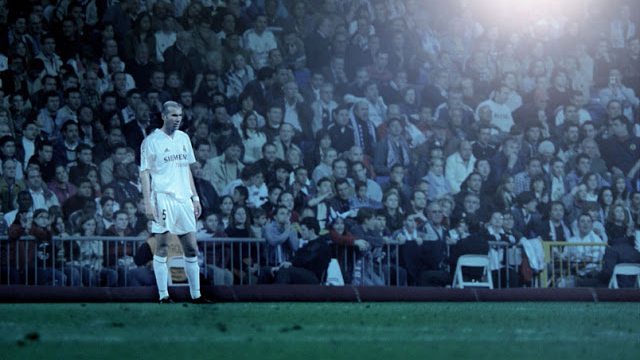
It is a testament to Zinedine Zidane’s career that his most infamous moment in football has been called an “ode to defeat”. That was the verdict of the artist Adel Abdessemed, who immortalised the 2006 World Cup final headbutt in a controversial statue, Coup de tête.
The statue stands an imposing 16ft tall and was put on display in Doha, Qatar, before being removed for glorifying violence.
Zidane’s final act
Zidane had announced that the 2006 World Cup would be his last act as a professional player. For his story to end in triumph rather than disappointment, France had to win the tournament. He carried his team all the way to the final and was rightly named player of the tournament.
The final itself took place in Berlin, between France and Italy. Zidane’s headbutt on Marco Materazzi, his fellow goalscorer that night, was his final act on a football pitch, and he delivered it with as much grace and panache as some of his finest goals. Materazzi, to his credit, went down like a man who had been waiting his whole career for the moment.
The French victory was used very widely as a metaphor for successful French integration
Jonathan Ervine
France went on to lose on penalties. Rather than criticise Zidane, the French press chose to celebrate his career as a whole. Jacques Chirac, then president, shared the sentiment: “You are a virtuoso, a genius of football and an exceptional human being. That is why France admires you.”
If geniuses were not flawed, they would not be geniuses in the first place. Connoisseurs of football regard Zidane as a singular talent, in the same way that Mozart is regarded as a virtuoso by the influential voices in classical music. And like Mozart’s admirers, Zidane’s want to uncover the truth about his journey to genius.
A symbol of multiethnic France
It is Zidane’s mastery of the game that makes his flaws so intriguing. His weaknesses leave a gap that invites cultural and artistic interpretation, and his story is all the richer for the range of communities that identify with him. He is arguably the best-known Frenchman in the world, and within France he became the symbol of a multiethnic society, a status his footballing talent afforded him.
As the researcher Jonathan Ervine writes of France’s 1998 World Cup triumph, “the French victory was used very widely as a metaphor for successful French integration.” Zidane, whose father was an Algerian immigrant, was the obvious individual example.
Football has been bent to political ends the world over for as long as the game has existed, and France leaned heavily on the achievements of Zidane and his teammates during their glory years.
Ervine adds: “This closes a chapter of French history because it shows one can remain faithful to an Algerian nationalist father and yet be for France, that one can be a Muslim and be fully French.”
Football’s last great showman
Clubs buy players for their football first and their media clout second. Zidane showed how much influence a charismatic footballer can have beyond the pitch. He was the leading player in a global sport, one with a larger following than any country or religion.
“To be talked about is to be part of a story, and to be part of a story is to be at the mercy of storytellers – the media and their audience. The famous person is thus not so much a person as a story about a person.”
Leo Braudy
Zidane was at times over-emotional, and he thrived on the big occasion. In a sport overladen with mundane, media-trained bores, he was the last great torchbearer of theatrical football, and his stage presence is sorely missed.
As an audience, we were gripped. Zidane’s career was never short of a plot twist, and the last came right at the end: the cathartic headbutt, a poetic finale to football’s greatest work of art.
Read next: Diego Maradona review and Should we celebrate Dennis Rodman?


Leave a comment