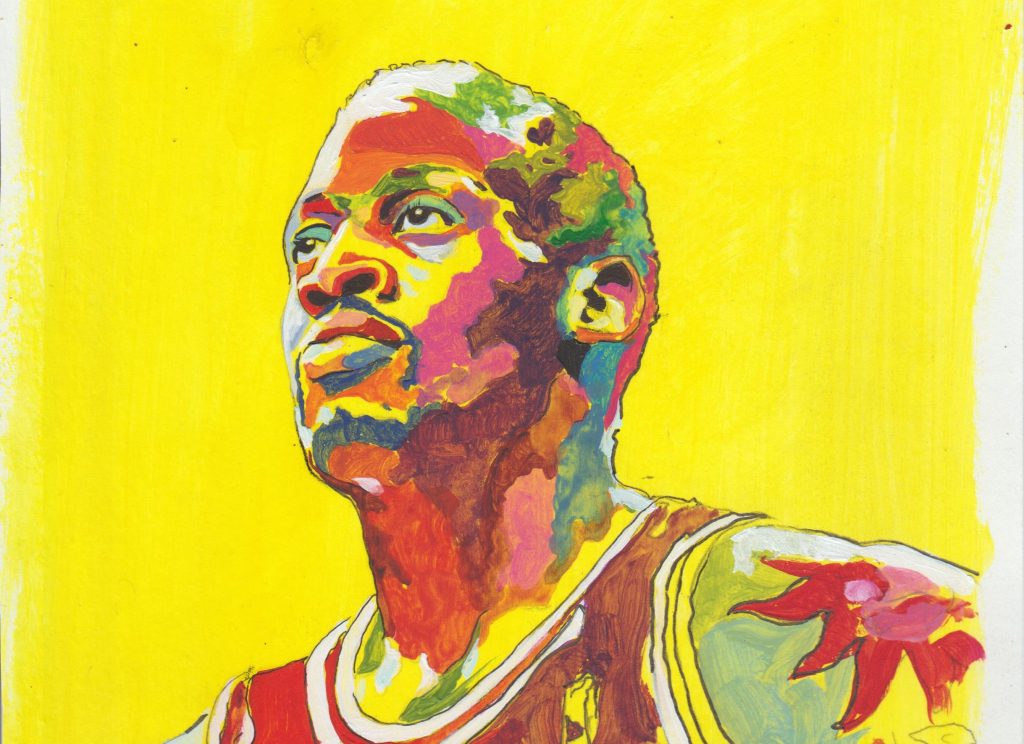
Thanks to the hit Netflix documentary The Last Dance, there is a wave of nostalgia for the 1990s Chicago Bulls, one of the most dominant teams in basketball history. At the centre of it is Dennis Rodman, the Bulls’ enigmatic power forward from 1995 to 1998.
The series was watched by 23.8 million households in its first month, and the cult of Rodman has re-entered popular culture with it. As a high-profile athlete, he challenged the image of the hyper-masculine sportsman at every turn. He frequented gay bars, covered his body in piercings and tattoos, and once dyed a red AIDS ribbon into his hair for the 1995 playoffs, at a time when the stigma around HIV was at its height, especially in macho NBA locker rooms.
A style icon, 25 years late
There is an irony, though, in the media’s sudden glorification of Rodman’s stigma-shattering style. Recent pieces in Esquire and GQ fail to acknowledge the vitriol he endured for his fashion choices in the ’90s.
“Unlike the Material Girl, this much-tattooed, much-pierced, overdyed basketball star is style clueless, off the court or on, in drag or out.”
Baltimore Sun, 1996
Rodman and the gay community
Rodman has always seen himself as an important figure for the gay community. In his 1996 autobiography Bad As I Wanna Be, he wrote: “I think I’ve done more to reconfigure them than any other professional athlete.”
During his playing days, Rodman was one of the biggest champions of LGBTQ+ athletes, despite not being gay himself, and he used his platform to push the NBA towards a more open and accepting culture. At the time of writing, the league has no openly gay active players. If that is going to change, more straight players need to follow Rodman’s lead. The responsibility can’t rest on the shoulders of gay players alone, in a sport that still makes coming out so difficult.
Most major sports teams keep a stranglehold on their star assets 24 hours a day. Rodman was different. As soon as he stepped off the court, he no longer represented his team. He was his own man.
“Rodman doesn’t give a flying halter top what the N.B.A. thinks of him.”
Sports Illustrated, 1995
Compare that with his teammate Michael Jordan. During a 1990 Senate race in Jordan’s home state of North Carolina, the Democrat Harvey Gantt, an African American, was running against the Republican Jesse Helms, a notorious racist. Jordan refused to endorse Gantt, explaining simply that “Republicans buy sneakers, too”. It’s hard to imagine Rodman taking the same approach.
To promote his autobiography in 1996, Rodman turned up to a book signing in a custom-made wedding dress to marry himself, a union that, as far as we know, is still going strong. He also used the occasion to publicly proclaim his bisexuality. The outfit was gender-bending, but it had nothing to do with how Rodman identified. It was a publicity stunt, and it worked: a week later the book was number one on the New York Times bestseller list.
In October 1993, while grieving a failed marriage and the departure of his beloved coach Chuck Daly, Rodman was found by police asleep in his car in the car park of the Pistons’ arena, with a suicide note and a loaded rifle. Instead of killing himself, he wrote in his autobiography, he “killed the Dennis Rodman that had tried to conform to what everybody wanted him to be.”
Rodman’s individuality is something that should be celebrated, particularly in the formulaic world of sports media
From that moment, Rodman’s career transcended basketball. He became as famous for his antics off the court as for his prowess on it.
The case against Rodman
His individuality deserves to be celebrated, particularly in the formulaic world of sports media. But glorifying the law-defying Rodman sets a dangerous precedent. In this new wave of Rodman fandom, his multiple arrests for domestic violence, including a 2008 case in which he pleaded no contest, are nowhere to be seen. The NBA’s list of openly gay players is short. Its list of players charged with domestic violence is not. On this front, Rodman did nothing to reconfigure the idea of the hyper-aggressive male athlete, and his past should not be ignored. It should be held up as a lesson to the NBA about basic human decency within its ranks.
It’s hard to celebrate Rodman the man in light of his crimes. At his best, he is a breath of fresh air, an artist trapped in the body of an elite athlete. At his worst, he is destructive and violent towards women.
Should we celebrate a man like that?
Without Rodman, we might not have had Colin Kaepernick, Frank Ocean or Billy Porter, to name a few. He paved the way for athletes and artists to express themselves beyond their industries and to use their profile for the greater good.
But giving sports stars like Rodman a free pass for domestic violence undoes all the work he did to challenge toxic masculinity in sport. We should acknowledge Rodman for who he is, good and bad, if we want to see real change in the NBA and beyond.
- Illustration by Polina Kalentsits
Read next: Zinedine Zidane: race, grace and brutality and Diego Maradona review


Leave a comment